 Search
  1-844-PUSHPAY
 Best online giving platforms for churches
Compare church giving platforms on fees, recurring giving, and donor retention so more of every gift actually reaches your ministry in 2026.
A giving platform has two main roles. First, obviously, it processes donations. Second–but not necessarily secondarily–it affects whether people give in the first place and if they continue to give.
The fee is generally easy to spot on a pricing page, but the second role is less obvious and often more valuable. For example, a platform that lowers your card rate by 0.7% but lets expired cards end recurring gifts could cost you more than it saves. So, compare fees, but make sure you look beyond them.
This guide compares the giving platforms that are considered the main players in the space: Pushpay, Planning Center Giving, Tithe.ly, Givelify, Subsplash, and Givebutter.
Start with the fee, but don’t stop there
There are two numbers that really affect your processing costs, but most churches only focus on one. The card rate is what you usually see. The ACH (bank transfer) rate, though, can save you a lot, since a recurring donor using a bank draft is, in most cases, cheaper than a card fee.
Here’s where the major platforms land in 2026.
| Platform | Best for | Card fee | ACH fee | Monthly platform fee |
|---|---|---|---|---|
| Pushpay (Everygift) | Growing and multi-site churches focused on recurring giving and donor retention | 2.9% + $0.30 | 1% + $0.30 | Quote-based (annual) |
| Planning Center Giving | Fee-conscious churches that don’t want a contract | 2.15% + $0.30 | $0.30 | $0–$239 |
| Tithe.ly | Small to mid-size churches wanting fast, low-cost setup | 2.9% + $0.30 | ~1% | $0–$149 |
| Givelify | Churches wanting a zero-commitment giving app, live today | 2.9% + $0.30 | n/a | $0 |
| Subsplash Giving | App-first churches already invested in Subsplash media | 2.3% + $0.30 | 1% | Quote-based |
| Givebutter | Tiny churches and one-off campaigns on no budget | 2.9% + $0.30 | Varies | $0 (tip-supported) |
Why fees alone don’t decide it
Consider the fee-coverage feature that most platforms offer, where donors can choose to add a bit extra to cover processing costs. When donors do this, your actual fee can drop close to zero, no matter what the listed rate is. This one action can have a bigger impact on your budget than a small difference in card rates. So, the platform that encourages donors to cover fees and helps keep recurring gifts going when cards expire is more valuable than one that just looks good on a pricing chart.
Features like card updater tools, automatic retries for declined gifts, and ACH failover may not seem exciting, but they make a big difference in how much pledged giving actually comes through. These details don’t often appear in feature comparisons, but they are where platforms can really differ.
Pushpay and the money you never knew you were losing
Every church with recurring online giving loses some of it every month, and most never see the number. A donor’s card expires. A bank flags a transaction. A gift declines on the third of the month and nobody follows up, so a faithful giver simply stops giving without ever deciding to.
This is the problem Everygift® was built around. Pushpay’s proprietary system of giving tools automatically retry failed gifts, prompt donors to update expired cards, and queue donations when a payment gateway goes down so they process once it’s back. The scale of what that recovers is the part churches don’t expect. Across Pushpay churches, Failed Payment Recovery brings back roughly $74 million in gifts a year that would otherwise have vanished, and when donors get the make up missed payment prompt, about 80% say yes. That’s money already pledged by people who fully intended to give, rescued from a silent technical failure.
The conversion side works the same way. Everygift uses giving history to recognize when a one-time giver is behaving like a recurring one, then invites them onto a schedule at the moment they’re most likely to say yes.
Planning Center Giving
If you’re less interested in features that build giving and more focused on keeping fees low, Planning Center Giving is a strong choice. Card donations run 2.15% plus $0.30, ACH is a thirty-cent flat fee, and the whole thing rides on a $15 monthly subscription with no contract and no volume games. It’s the same rate for a church of 100 or 1,000.
Planning Center Giving works well with other Planning Center tools if you already use their People or Services modules, and the giving process is straightforward. Compared to Pushpay, you miss out on the strong recovery and conversion features. Planning Center handles giving efficiently and keeps costs low, but it doesn’t focus on growing your recurring donors for you.
For churches that are already using Planning Center, check out how Pushpay integrates with PCO so that you can get the benefits of Everygift while keeping your member records in Planning Center.
Tithe.ly
Tithe.ly is a great choice for small churches that just want to get digital giving up and running. As your giving program grows and you start focusing on keeping recurring donors, you’ll want to pay more attention to the recovery features, which is where premium platforms stand out.
They offer a free tier that provides a small church online without requiring a budget meeting. Text-to-give, recurring options, and the donor’s ability to cover fees are all there.
Givelify
Givelify is the answer when commitment is the obstacle. No monthly fee, no contract, a 2.9% plus $0.30 card rate, and an app your congregation can give through almost immediately. For a church that wants to test online giving or run a quick campaign without signing anything, it’s hard to beat the friction-free start.
Givelify is mainly a giving app. You shouldn’t expect advanced donor development tools or management integrations like you’d find in a full platform. But for what it’s designed to do, it works very well.
Subsplash Giving
Subsplash Giving is best for churches already using Subsplash for their app, media, and streaming. The giving-only product charges 2.3% plus $0.30 per card gift, with 1% for ACH. If your main digital connection with your congregation is through a Subsplash app, it can make sense to keep giving there too.
Givebutter
Givebutter is a good option for very small churches and one-time fundraising efforts. Its main tools are free, supported by optional donor tips, and standard processing fees apply if tips are turned off. For a new church or a single campaign, starting with a free tool is appealing. Just keep in mind that Givebutter is designed more for general nonprofit fundraising than for regular church giving, so consider if it fits your needs.
“But free sounds better than a contract”
If you’ve landed in this guide, you are probably comparing a free or low-fee tool with a premium one.
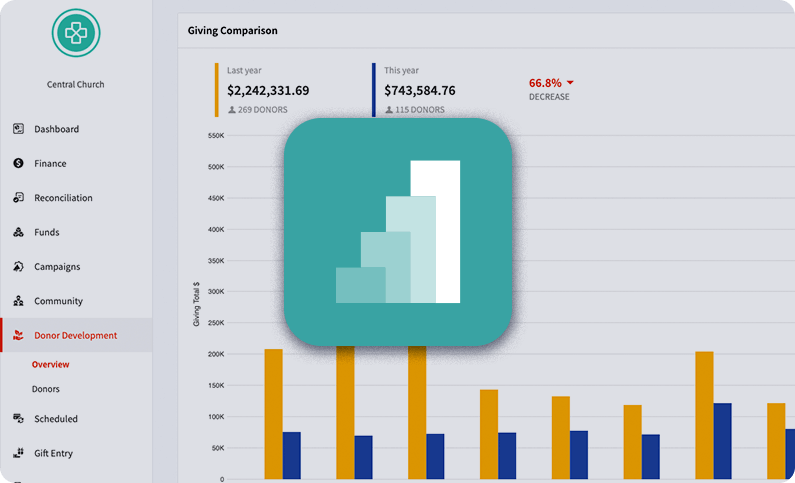
Focus on the total amount you actually receive, not just the fees you pay. For example, if your church gets $40,000 a month in online giving, a low-fee platform might save you a few hundred dollars compared to a premium one. That’s real savings. But if the premium platform helps recover failed recurring gifts and turns one-time givers into regular donors, even a 5% increase means $2,000 more each month, which is much more than the fee savings.
This calculation only makes sense if your giving volume is high enough. For small churches that aren’t looking for a “premium” giving experience, the free tool is a genuinely good choice.
The real question isn’t just about free versus premium. It’s about whether your giving is large enough that recovering and growing gifts is worth more than saving on fees.
A checklist before you commit
Bring these to any demo and get real answers, not feature tours.
- What are the rates? Get the card fee and the ACH fee, and ask which one a typical recurring gift will run on.
- What happens when a card expires? Ask exactly how the platform handles declined and expired recurring gifts. Does it retry, prompt the donor, and recover the gift, or just fail silently?
- Can donors cover fees? Confirm the fee-coverage option exists and how prominently it’s offered, since donor opt-in can erase most of your processing cost.
- How fast can people give? Time it yourself. Count the taps from “I want to give” to “done.” Every extra step costs you gifts from first-time visitors.
- What’s the total cost at your volume? Add the monthly fee plus fees on your real giving numbers. The cheapest headline rate isn’t always the cheapest outcome.
- Is there a contract? Month-to-month versus annual changes your risk if the fit is wrong. Know before you sign.
- Where does the data go? If giving doesn’t flow into your church management database automatically, someone is reconciling it by hand every week.
No platform is perfect in every area. Choose the one that matches your top two or three priorities and has weaknesses you can accept.
Where to start
The best online giving platform for your church in 2026 depends on what’s really costing you money. If you need something affordable and simple, Planning Center Giving or a no-contract tool like Givelify will get you started quickly and cheaply. If you’re most interested in protecting your givers data, increasing recurring giving, and providing the smoothest giving experience, a recovery-focused platform like Pushpay is designed to meet your needs.
See how Everygift secures and grows generosity for your church.