 Search
  1-844-PUSHPAY
CORONAVIRUS RESOURCES TO HELP YOU AND YOUR CONGREGATION STAY CONNECTED WHEN IT’S CRITICAL
- Power up Your App: Stay Connected If In-person Services Are Reduced
- CHECKLIST: How to pivot your church to a digital strategy in times of crisis
- Essentials for Great Emergency Communication
- What Your Church Can Learn About Digital Strategy from Champions Centre’s COVID-19 Response
- How Mosaic’s Digital Strategy is Helping Them Thrive During COVID-19
- 5 Characteristics of Effective Mobile Notifications During a Crisis
- Facebook Live with Chad Zolo, Online Pastor at Elevation Church | Discussion on pivoting church online and doing ministry digitally
- Facebook Live with Mark Venti, Executive Pastor of Churchome | Rethinking methods on what Churchome is doing differently in the midst of the COVID-19 outbreak
- Facebook Live with Erwin McManus, founder and Lead Pastor of Mosaic | Easter weekend at Mosaic and how the COVID-19 pandemic is shaping the future of the Church
- 6 Ways to Engage Your Online Community Better
- 5 Tips for Communicating With Your New Givers
- 8 Ways to Change Up Your Weekend Service
In the past few weeks, COVID-19 has spread to 50 states. Schools, businesses, churches, events, and other organizations are wrestling with how to respond to the growing threat of coronavirus, the strain on local healthcare systems, and the fear that is consuming our country.
Some regions have been affected more than others. Every church has to prayerfully consider what they’re capable of doing in response to this public health crisis and make the right decisions for their congregation and community.
Countless churches around the country have moved to online-only events or explored alternative ways to meet with those who are able. Digital tools and channels that were once considered optional are rapidly becoming essential. In the weeks to come, it’s likely that just about every church in the US will move to online-only.
The situation looks bleak. But it’s also led to an unprecedented push to modernize the way we do church, and the decisions you make right now could lead your congregation to reimagine what it means to be part of the body of Christ.
In this guide, we want to help your church staff answer:
We’ll also explain how to calculate the risk of exposure in your congregation.
Should your church continue meeting in person?
Short answer: probably not.
While the CDC hasn’t formally shut down gatherings, they’re recommending against groups of 10 or more, particularly “conferences, festivals, parades, concerts, sporting events, weddings, and other types of assemblies.” The recommendation doesn’t explicitly mention church services, and it isn’t binding for now. And it isn’t intended to overrule recommendations from your local public health officials.
So what should your church do?
Your staff members likely already have strong feelings about whether or not your church should continue meeting in-person. Some, surely, feel that it is all overblown, and that the frenzy shouldn’t interfere with your church’s regular operations. Others are undoubtedly urging you to exercise caution and stop anything that could accelerate the spread of coronavirus.
It’s not a decision any church is making lightly. But it’s important that your decision is formed thoughtfully, and not driven by emotions or assumptions. Many people in your community are genuinely afraid—for their own lives or the lives of their loved ones. How you respond could have a lasting impact on how your congregation and community perceive your church.
Here’s how you should decide whether or not to move to an online-only service:
FOLLOW GUIDANCE FROM PUBLIC HEALTH OFFICIALS AND GOVERNMENT
For many churches, the decision has already been made for them. Washington state was the first to officially close all public schools and ban large in-person meetings, including faith-based gatherings. (The ban now extends to groups of 50, as well as bars and restaurants.) Other states quickly introduced similar closures. This will probably continue to ripple throughout the United States as the number of confirmed cases increases in other communities.
Even if your state hasn’t prohibited large gatherings or closed schools, your public health department has likely made recommendations. Your church should take cues from your local public health and government officials before making a decision. Some churches have come up with innovative solutions and alternative ways to gather, like Grove Church in Marysville, which attempted a “drive in” church experience (like the old drive-in movie theaters, but for a church service).
Local recommendations should be the first factor you use to decide on in-person services. If your local recommendations are more lenient, you should still strongly consider the CDC’s nation-wide recommendation—and think about the cost of ignoring it. Just because gathering isn’t prohibited doesn’t automatically mean you should continue holding regular in-person services.
There’s more to consider.
PREVENTIVE VS. RESPONSIVE ACTION
People are making a lot of decisions out of fear right now. Some seem like irrational overreactions, but there’s a lot to be said for taking responsible, preventive measures as well.
If your church hasn’t been directly affected yet, it may seem extreme to cancel in-person services, but preventive measures like “social distancing” are crucial to slow the spread of the virus. This reduces the strain on your local healthcare system and ensures that when your community is impacted, your most vulnerable members can get the care they need.
By now, you’ve probably heard of the concept of “flattening the curve,” which refers to this graph:
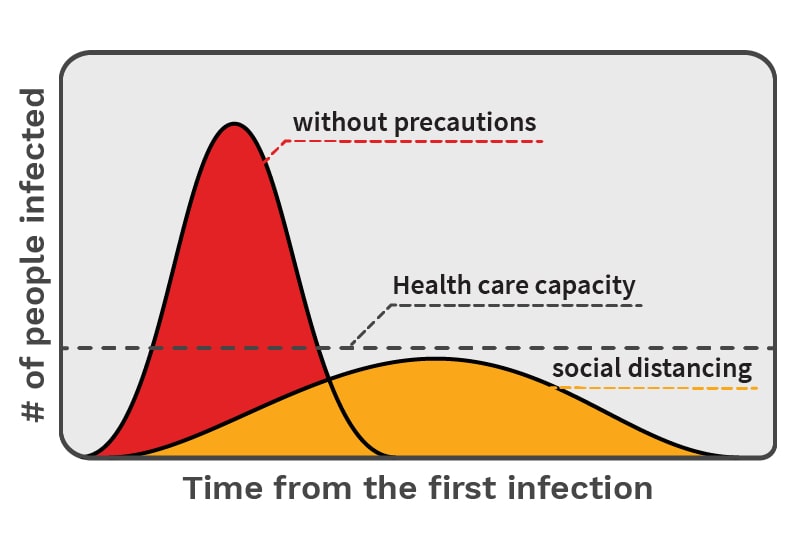
The earlier your community takes preventive measures (like canceling services), the less severe the virus’ impact will be in your area. Only taking reactive measures (canceling when there’s a confirmed case in your county or congregation) could mean that down the road there won’t be enough hospital beds—or worse, not enough ventilators for the most severe cases.
The difficult thing about flattening the curve is that to be effective, it has to look like you’re overreacting. If everyone waits until there’s ample evidence that precautions need to be taken, it’s too late for a lot of people to benefit from them.
DON’T JUST LOOK TO PUBLIC LEADERS—BE THEM
Communities around the US are looking to local leaders for guidance, assurance, and recommendations right now. In many cases, it has felt like a free-for-all, where every company, church, and event is having to make decisions on their own.
This is a chance for your church to model a rational response to a pandemic that is rooted in faith and not fear, with love and compassion for your community’s most vulnerable members.
Whatever your decision, make it prayerfully and share it publicly. Think about how your leadership right now will look when this is all over. And if there is a leadership void in your community, fill it.
Now let’s talk about your church’s digital strategy.
How to transition to online-only church
Some churches have essentially been forced into being online-only. Others are choosing to do it out of an abundance of caution. Some are simply making live streaming an option. But every church in the US should be prepared for this transition.
Your ministry thrives on personal relationships. But while right now you need to reduce physical touch points, you have an opportunity to increase digital touch points. And while these may feel like temporary solutions, this moment has the potential to permanently enhance your ministry.
Going digital is going to feel very uncomfortable at first. Most churches add live streaming to a typical service, but you’ll be preaching in an empty room. But what you invest right now and the experience you collect along the way will pay dividends long after the panic wanes.
Here’s what you should be prepared to do:
LIVESTREAM YOUR SERVICE
Over the last few years, a lot of churches have used live streaming as a way to serve members who were out of town or sick. Now, it’s a necessity for everyone. And thankfully, it’s easier than it’s ever been. Ideally, you should invest in a high-quality live streaming setup. But if coronavirus cancellations caught you by surprise, you can literally use a mobile device and social app.
When coronavirus fears intensified in Bellingham, Washington, Hillcrest Church decided to do a last-minute livestream. It was in the middle of the week and they didn’t have a camera, but one of the pastors had an iPad. They sent out an email announcing the livestream, posted about it on Facebook, and then used Facebook Live. About 750 people attend Hillcrest, and more than 200 tuned into this impromptu iPad livestream. (The following weekend they had a much better setup, and more than 3,000 views of their livestream.)
You don’t have to think of live streaming as some big production—especially not right now. Do what you can to keep your congregation connected. Give your livestream prominent placement on your church website and in your church app, and then promote it on social media and through email.
Remember: live streaming has always been about trying to replicate the in-person experience for a digital audience. If no one is sitting in your pews, that doesn’t change a thing. Your congregation is still “with you.” They’re just online. You’re not talking to an empty room; you’re still worshiping with the people who typically fill those seats.
So as strange as it will feel, try to facilitate your usual service experience: worship, sermon, announcements, everything.
Get more tips in our free ebook, Don’t Lose Your Online Guests.
KEEP PEOPLE UP-TO-DATE IN YOUR CHURCH APP
Your app should be a hub for everything that’s going on in your church. That should be the case whether there’s a public health crisis or not, but it’s more important now than ever. People want to stay connected to your church, and as long as you keep it up-to-date, an app is one of the best ways to help them explore your content, find out what’s going on, and interact with your church. It’s simple, intuitive, and it can host text, images, video, audio, giving, and more in a clear, organized format.
No matter how much you’ve talked about your app over the years, odds are a lot of people in your congregation still don’t have it. So use your other channels like email, social media, and your website to encourage people to download it, and let them know that this is the best way to stay connected with you during this time.
If you don’t have a church app, Pushpay offers a great option that allows you to connect with your church community any day of the week. You’ll also be able to send push notifications to your people so they always know about any important church updates.
TAKE ATTITUDE POLLS
One of the greatest challenges in the coming months will be finding ways to actually interact with church members. A quality church app like Pushpay gives you a range of ways to interact with people who aren’t in the room.
Invite your congregation to participate in the service by responding to polls and sharing the results. Attitude Polls let you make a custom statement which church members can respond to with:
- Strongly agree
- Agree
- Neither
- Disagree
- Strongly disagree
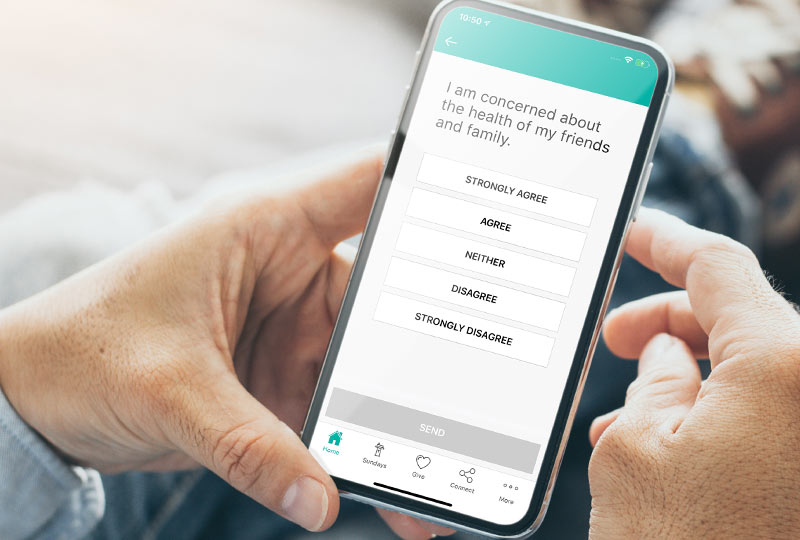
You’ll see your church’s responses in a convenient tab, and you can share the results with your staff or congregation.
Here are some things you might poll your congregation about to gauge their attitude and needs in the midst of the COVID-19 outbreak:
“I am afraid for my own health right now.”
“I am concerned about the health of my friends and family.”
“I think [church name] is doing enough to address the novel coronavirus in our community.”
“I want to know how to help the sick and vulnerable in our community.”
“I trust that God is in control.”
“I’ve been leaning on Scripture to get me through this time.”
If you take an Attitude Poll, be sure you remind people that they’re anonymous, so they can be completely honest. This is about getting a sense for how your church as a whole feels, not for singling anyone out.
CREATE FILL-IN-THE-BLANKS IN YOUR APP
A lot of churches use some type of fill-in-the-blank notes to help people follow along during the service. Going digital doesn’t mean that has to stop. You can still use fill-in-the-blanks in your Pushpay app—just let your congregation know that it’s available and tell them where to find the blanks.
Watching from home, church members will likely have more distractions than they’re used to. So fill-in-the-blanks can be a great way to keep them anchored during your service.
PROMOTE ONLINE GIVING
The plate is gone. But that doesn’t mean giving has to stop or even slow down. In fact, with the convenience of Pushpay and features like recurring giving, you may find that some people will start giving more, because giving with a tap from the comfort of your couch is far easier than writing a check or stopping at an ATM before the service. Once people start giving digitally, they may never go back.
At the same time, it’s going to be increasingly important that churches be sensitive to possible financial hardships. More church members than usual are going to experience significant healthcare expenses, job loss, and other financial difficulties. Christians are called to be generous in the good times and the bad, and a lot of churches are about to become very dependent on digital giving, but it’s important to talk about giving without pushing people beyond their comfort zone or being insensitive to their circumstances.
You may also want to consider creating some new funds during this time. If you don’t already have some sort of benevolence fund, this could be a very important season to have one. As specific needs arise in your congregation and larger community, those could be worth creating dedicated funds for as well. In your Pushpay app, you can easily create new funds for your congregation to donate toward.
If anything, the coronavirus pandemic has demonstrated how important it is for churches to make a big issue out of prioritizing digital giving. Too many congregations who have made the tough decision to put gatherings on hold are completely reliant upon Sunday-morning offerings.