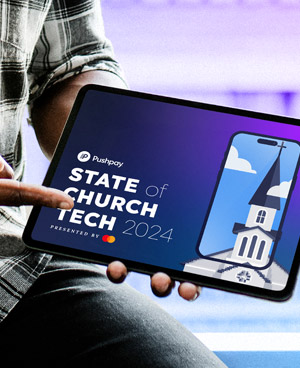
When ministry leaders are entrusted with the digital future of their ministry—and especially if they don’t have a thorough understanding of the constantly shifting church technology space—those leaders become hesitant to commit to technologies that could define the future of their community. I know this from experience; as Group Product Manager at Pushpay, my team and I feel that same trepidation every day.
Scouting the Road Ahead
As a leading technology provider for churches, Pushpay is constantly investigating and exploring the latest solutions that could benefit the ministries we serve. One of those up-and-coming tools is near-field connection (NFC) tags. This tech isn’t particularly new—if you’ve ever tapped your credit card to pay for groceries or petrol, you were using NFC technology.
Pushpay was approached by a supplier of NFC tags who thought they might be brilliant for churches. Their appeal made sense on paper. Scanning a tag on Sunday morning could send your congregants and guests to sermon notes, automatically donate a predetermined amount to a specific fund, or drive them to one of a dozen other use cases.
But just like the thousands of church leaders we surveyed for The State of Church Tech report, my team wasn’t confident about commiting straightaway. NFC tags were uncharted territory. There was no data, no statistics, no concrete results supporting this technology’s benefit for ministries. How could we feel confident promoting this solution and leading churches down this path?
Our team at Pushpay is uniquely privileged to have access to resources and the stalwart support of our leadership to explore potential channels for building the Church. In the case of NFC tags, we needed to generate data to make an informed decision. So we found a partner church willing to experiment with this new tech, funded their adoption efforts, and laid out clear parameters of what we’d consider a successful proof of concept.
Lessons Learned
Thinking back, I’m not sure I’ve ever laughed at a research finding. Who has, really? But one undeniable discovery during our NFC tag trial was just too much fun:
People don’t want to lean forward.
The church that trial-tested the tags has auditorium seating. This meant the seat in front of each attendee—where the tags were placed—was a foot in front of individuals and below their knees. Which meant potential donors couldn’t engage with the tags without leaning forward and stretching downward. Which, it turns out, no one wants to do. The tags essentially added an additional hurdle that slowed down Pushpay’s sub-ten-second giving experience.
Because of that discovery (and other less humorous reasons) their church saw no significant increase in giving during the NFC tag trial. As such, Pushpay decided not to pursue the technology further.
Once again, our team is very fortunate to have the resources to conduct experiments like this. But the majority of churches researching and considering implementing new tech solutions do not have that flexibility.
Let Data Be Your North Star
 Search
  1-844-PUSHPAY