Bulletins: One of the funny things about church bulletins is that we share most of the same information from the stage. It’s almost like we’re training people not to read them. When you teach your church to see the bulletin as a source of significant and exclusive information, they become more invested in reading it, making it a helpful source for the information they need to be aware of.
Pre-service slides: A lot of people are in their seats up to ten minutes before the service starts. Take advantage of this time to let people know what’s happening by displaying announcements. The key to doing this effectively is to design attractive and engaging slides. Don’t get carried away trying to cram a bunch of stuff in each slide or too many announcements in the morning’s rotation.
Choose two or three announcements slides every week.
Website: There should be a calendar of events on your site. When people know where to go to find up-to-date information, you won’t have to hold their hand to keep them informed.
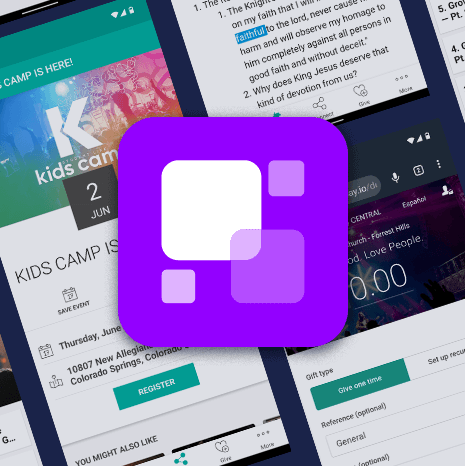
Mobile app: Your church’s mobile app is an announcement powerhouse. Most of the channels you would use to communicate your church’s goings-on can be accessed through your mobile app. On top of that, tools like push notifications and geofencing can be used to send reminders to specific groups based on various criteria.
3. Think about who you’re talking to
One of the biggest reasons people tune out of in-service announcements is because they’re often meant for a small segment of your church. Every time you use service time to speak only to men, small-group attendees, or business owners, you lose everyone else. If you do that too often, people check out before you even get started.
If you’re going to use service time for announcements, make sure they apply to a large percentage (if not all) of your audience. If you need to remind a small segment of your church about an upcoming event, find a more appropriate communication channel.
4. Make your announcements visual
When you visually reinforce information, people retain it better. If you want your announcements remembered, include a visual cue. Add a well-designed slide for each of your announcements. You don’t have to get all of the information in the image—just a few key points. You’ll find that using images in your announcements will draw and hold people’s attention better than just a person with a mic.
Pro Church Media has a lot of excellent links for free church media resources. You can use these in your announcements or use them as springboards for your own ideas. If you’re looking for high-quality stock photos you can use for slides, check out Unsplash. You’ll find a lot of great images for any number of applications.
5. Utilize video whenever you can
Video isn’t magic, so recording someone reading the announcements isn’t going to be more compelling than having them read from the stage. But if you approach it right, video can be a remarkably helpful tool for communicating with your congregation. It can be as easy as showcasing last year’s event or talking to people who have benefitted from similar programs you’ve done in the past.
Even if you’re a smaller church that doesn’t have its own media team, you’d be surprised at how easy it is to make engaging videos. Some churches produce incredibly engaging announcement videos with an iPhone and some free editing software. You just need to be creative as you think about ways to show rather than tell.
If you’re looking to get your feet wet in the video editing department, check out Lightworks, Hitfilm Express, DaVinci Resolve, and Shotcut. These video editors are free to get started and make creating video announcements a breeze.
6. When in doubt, use stories
We’ve already addressed the need to help church members see the connection between the what your church is doing and what it values. It’s also helpful to inspire people by helping them recognize the potential positive outcomes.
If you’re giving an announcement for a short-term mission trip, start with a story that demonstrates why this is important. Maybe you’ve taken multiple trips to this location, and you can talk about the impact it has had on the people you’ve served. You could also find someone in the church whose life was dramatically impacted by a short-term mission and inspire people that way. The key is to use stories to help people envision possibilities.
7. Find the right time for your announcements
Some churches make announcements at the beginning of the service, while others wait until the very end. Some even squeeze them in between the music and the message. Good luck trying to find any consensus on the best time. Churches are all over the map on this question.
It’s hard to come to any consensus because every church is different. You need to find the best time in the service for your congregation. Don’t stick to your current practice because it’s what you’ve always done. Is everyone too distracted at the beginning of the service to pay attention? Try closing with announcements. Are people starting to leave during the closing song? Move the announcements to earlier in the service.
Be intentional about how you arrange your service.
8. Work announcements into the sermon
Sometimes the best possible response will come from turning an announcement into a sermon illustration. People are listening intently to your message (hopefully), so use that as an opportunity to pitch your most important events.
Talking about the Great Commission? Use the sermon as a reason to talk about an upcoming fundraiser for missions. Are you holding a 50th-anniversary celebration for your church? Pitch it during a message on leaving a legacy. Find unique ways to work what your church is doing into your sermons.
9. Enlist your staff to lead from the pack
On the average Sunday morning, your staff and volunteers connect with a lot of people. Why not use that to the church’s advantage? Every week you can assign them an announcement or two to remind people about when they cross paths.
It doesn’t have to be a drawn-out spiel. It can be as simple as, “I’m hoping we’ll see you at the car wash this Saturday!” The benefit of this approach should be obvious. It’s a lot harder for people to blow off a direct invitation than it is to ignore an announcement from the pulpit!
10. Use a tag-team approach
There’s a reason why every morning show on the radio has two hosts. It allows them to play off of each other and create a more engaging and exciting dialogue. If the chemistry is right, it can create a fun (and informative) atmosphere. Why not try the same thing at church?
If your church has a couple of people with great chemistry, use them to give your announcements every week. Two people with the right rapport can be the recipe for an announcement segment that everyone looks forward to.
11. Keep visitors in mind
It’s already been said, but it’s important enough to touch on again. Don’t get too insider-focused. Churches often think of members when we make plans, and we pitch these opportunities to the church. It makes sense: They need the support of church members to sustain their various endeavors.
Unfortunately, this means that there are portions of the service where they’re only talking to regular attendees, and visitors feel like outsiders. Instead, churches should think about these things as opportunities to get visitors plugged in. And the only thing that needs to change is church’s perspective about announcements and the language that they use.
12. Stop using announcements as a recruitment tool
The minute a middle-school teacher starts asking for input and feedback, the same kids always put their hands up—and a lot the other kids do everything in their power to avoid eye contact. The same is true for grown-ups at church. If you use announcements as a time to try and drum up volunteers, you’re asking people not to pay attention.
It’s not a cardinal sin to use announcements to ask for help, but it should be rare. There are so many better ways to recruit people to serve. Don’t rely on announcements for it.
Is It Time to Consider a Mobile App?
Every once and awhile, a piece of technology comes around with the potential to solve a myriad of problems. For churches, a mobile app is one of those game-changing technologies. It’s not just that a church app will improve your announcement game; it has the potential to transform everything from your communication to your giving.
The Pew Research Center claims that 77 percent of Americans own smartphones, up from 35 percent in 2011. They’re using apps to do all kinds of things like shop, do their banking, get directions, and share their lives on social media. With your own church app, it can also be the tool they use to…
A lot of your church is already using their phones to read the Bible—and you’d probably be surprised to see how much of your website traffic is coming from mobile devices. Why wouldn’t you tap into that trend?
If you’re ready to learn more about how an app will jumpstart your engagement and breathe new life into your giving, talk to an expert today to get started!
take a self-guided tour
 Search
  1-844-PUSHPAY